
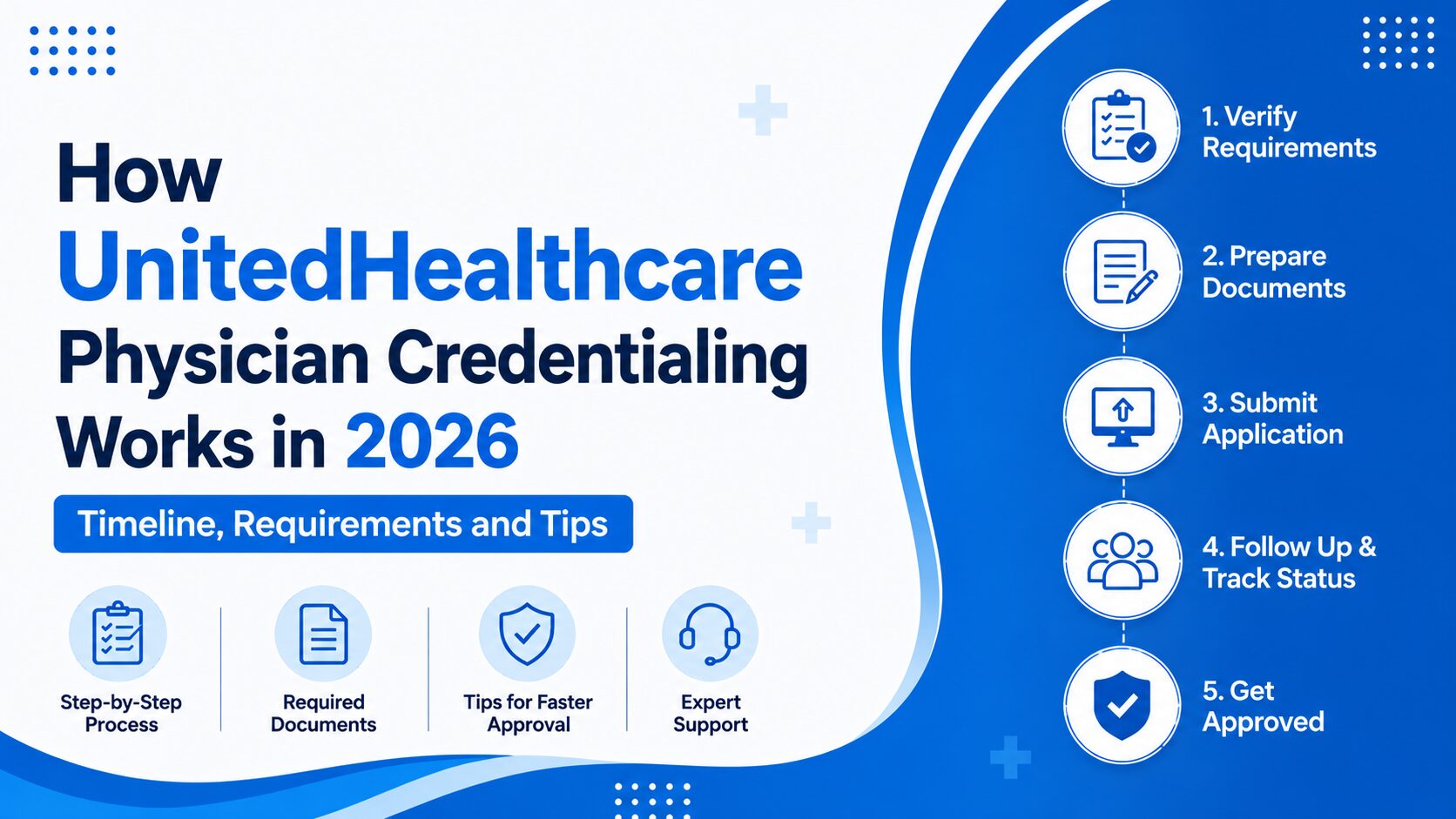
UnitedHealthcare physician credentialing in 2026 complete guide for faster approval and compliance
UnitedHealthcare credentialing is important for your healthcare practice to access one of the largest commercial payer networks in the U.S, covering millions of patients. In 2026, the process has become more compliance-driven, requiring precise data, verified documentation from your side, and it necessary for you to follow complete payer guidelines. As an experienced physician, you need to understand the full workflow, and it will help you to avoid delays and start billing faster.
Key Credentialing Overview
| Component | Requirement | Impact |
|---|---|---|
| Network Size | 48M+ members | High patient access |
| Primary System | CAQH + UHC portal | Data accuracy critical |
| Average Timeline | 45–90+ days | Revenue dependent |
| Verification Type | Primary source | High scrutiny |
How UnitedHealthcare physician credentialing works for new and established practices in 2026
The UHC credentialing process includes CAQH data submission, correct application filing, primary source verification, and final committee approval. Each step must align perfectly to move forward without delays. Both new and existing practices must follow this structured workflow to ensure approval and participation.
United Healthcare Credentialing Workflow Breakdown
| Step | Process | Common Issues / Risks |
|---|---|---|
| Step 1 | CAQH Profile Creation & Attestation | Incomplete provider data, expired attestation, missing supporting documents |
| Step 2 | Application Submission to UnitedHealthcare | Incorrect NPI, taxonomy mismatch, outdated practice/location details |
| Step 3 | Primary Source Verification (PSV) | Delays in license verification, malpractice history review, board certification gaps |
| Step 4 | Credentialing Committee Review | Application flagged for additional review, incomplete documentation, approval delays |
| Step 5 | Contracting & Network Enrollment | Contract negotiation delays, fee schedule issues, slow system loading/activation |
UnitedHealthcare credentialing requirements for physicians timeline documents and approval process
It is necessary for physicians and your healthcare practice to submit accurate documentation, including licenses, malpractice insurance, and a complete work history to UHC. Timelines vary depending on application quality and verification speed, often extending beyond the expected duration from United Healthcare insurance. Proper preparation helps reduce unnecessary delays and ensures faster approvals.
| Requirement | Details | Risk if Missing or Incorrect |
|---|---|---|
| State License | Active, unrestricted license in the state of practice | Immediate processing delay or automatic application rejection |
| Malpractice Insurance | Current liability coverage meeting payer minimum limits | Application denial or request for additional documentation |
| Work History | Minimum 5 years of continuous, gap-free professional history | Application flagged for review, additional verification required |
| Board Certification (if applicable) | Valid and up-to-date specialty certification | Lower approval priority or credentialing delays |
| CAQH Profile | Fully completed and attested CAQH application | Application cannot be processed or significant delays |
| Credentialing Timeline | Typically 45–90+ days depending on completeness and payer workload | Revenue cycle delays, postponed patient service billing |
Step by step UnitedHealthcare physician credentialing process and how to avoid delays in 2026
Credentialing begins with CAQH setup and continues through submission, verification, and approval stages. Most delays occur due to incomplete applications or mismatched data across systems. A proactive approach with accurate documentation and follow-ups ensures smoother processing.
United Healthcare Credentialing: Delay Prevention Strategy (Enhanced)
| Issue | Root Cause | Recommended Solution |
|---|---|---|
| Application Processing Delay | Missing or incomplete supporting documents (license, insurance, W-9) | Perform a comprehensive pre-submission document audit and checklist verification |
| Verification Hold (PSV Delays) | Mismatched data between CAQH, application, and supporting records | Standardize provider information across all platforms before submission |
| Application Rejection | Incomplete or outdated CAQH profile and attestation | Maintain an up-to-date CAQH profile with quarterly reviews and timely attestations |
| Slow Credentialing Approval | Lack of proactive follow-up with payer and credentialing team | Implement weekly follow-ups and track application status through payer portals |
| Contracting Delays | Delayed response to contract terms or missing signatures | Review and respond to contracts promptly with designated point of contact |
| Enrollment Activation Lag | Errors in EFT/ERA setup or billing information | Ensure accurate enrollment setup and confirm activation before billing |
UnitedHealthcare physician credentialing common mistakes delays and solutions
Common errors include your practice’s outdated CAQH profile, inconsistent data of your practice, and missing documentation from your side. These issues can pause or restart the credentialing process of your healthcare practice, leading to significant delays for your healthcare practice, and our experts will identify and resolve these mistakes to improve the approval timeline for your healthcare practice.
| Mistake | Impact on Credentialing | Recommended Fix | How Stars Pro Helps |
|---|---|---|---|
| CAQH Not Attested / Expired | Application cannot proceed or gets placed on hold | Attest and update CAQH profile every 120 days | Stars Pro monitors CAQH profiles and ensures timely attestations to avoid processing interruptions |
| Provider Data Mismatch | Primary Source Verification (PSV) failure and delays | Align NPI, CAQH, and application data across all systems | Stars Pro standardizes provider data across all platforms before submission |
| Missing Documentation | Application delays or repeated requests from payer | Use a complete document checklist before submission | Stars Pro conducts pre-submission audits to ensure all required documents are included |
| Unexplained Work History Gaps | Application flagged for additional review | Provide written explanations for any gaps in work history | Stars Pro prepares and validates work history details to prevent review triggers |
| Outdated License or Insurance Info | Immediate delay or rejection risk | Keep all credentials and policies current and verifiable | Stars Pro tracks expiration dates and updates documents proactively |
| Incorrect Practice Location Details | Enrollment errors and claim rejections post-approval | Verify and update all service locations accurately | Stars Pro ensures accurate facility and location mapping during enrollment |
How UnitedHealthcare physician credentialing delays impact your revenue and patient access
Credentialing delays prevent you from billing as in-network providers, it will reduce reimbursement and limit your patient access. Patients always prefer to choose in-network providers, which affects the patient volume of your healthcare practice. Early credentialing helps you maintain steady cash flow and patient retention.
| Delay Duration / Issue | Impact on Revenue & Operations | Estimated Financial Effect | How Stars Pro Helps |
|---|---|---|---|
| 30 Days Delay | Unable to bill as in-network provider; reliance on out-of-network or self-pay patients | Reduced billing volume and slower cash flow | Stars Pro accelerates application submission and ensures clean documentation to minimize initial delays |
| 60 Days Delay | Loss of in-network patient volume; reduced reimbursements | Approx. 15–20% revenue loss | Stars Pro performs proactive follow-ups and resolves verification issues quickly |
| 90+ Days Delay | Significant drop in patient retention and referral flow | Approx. 25–30% revenue loss | Stars Pro manages end-to-end credentialing to shorten approval timelines |
| Claim Denials (Post-Services) | Services rendered before credentialing approval are often denied or non-reimbursable | Potential permanent revenue loss | Stars Pro ensures proper enrollment activation before billing to avoid denials |
| Limited Patient Access | Patients prefer in-network providers, reducing appointment bookings | Decrease in patient volume and long-term growth | Stars Pro helps providers get in-network faster, improving patient acquisition |
Why UnitedHealthcare physician credentialing is more complex than most physicians expect?
UHC credentialing involves multiple systems in the credentialing processes for patient safety, and these processes include strict verification of practices and detailed compliance requirements from providers. As an experienced physician, you must ensure accuracy across all platforms to avoid delays or rejections. This level of complexity often surprises providers who expect a simpler enrollment process.
| Complexity Factor | Detailed Description | Impact on Providers | How Stars Pro Helps |
|---|---|---|---|
| Multi-System Process | Requires coordination between CAQH, UnitedHealthcare portal, and sometimes third-party systems | Increased risk of data inconsistencies and submission errors | Stars Pro synchronizes all systems to ensure accurate and consistent data submission |
| Primary Source Verification (PSV) | Extensive verification of licenses, education, board certification, and work history directly from original sources | Delays due to slow responses from licensing boards or institutions | Stars Pro proactively follows up with verification sources to reduce waiting time |
| Strict Compliance Requirements | Must meet federal, state, and payer-specific credentialing standards and documentation rules | Higher rejection risk if even minor compliance details are missed | Stars Pro ensures full compliance with all UHC and regulatory requirements before submission |
| Data Accuracy Across Platforms | All provider data must match exactly across CAQH, NPI registry, and UHC systems | Mismatches can trigger verification failures or application holds | Stars Pro arranges and audits provider data across all platforms |
| Timeline Variability | Credentialing timelines vary widely based on completeness, reviewer workload, and verification speed | Unpredictable approval timelines impacting revenue planning | Stars Pro provides active tracking and regular updates to keep the process moving |
| Frequent Updates & Attestations | CAQH and supporting documents require ongoing updates and periodic attestations | Expired or outdated data can restart or delay the process | Stars Pro monitors and maintains all profiles to prevent interruptions |
How we complete UnitedHealthcare physician credentialing faster and reduce rejection
At Stars Pro, our CPC-certified specialists use a structured approach with accurate documentation, updated CAQH data, and regular follow-ups to improve approval speed. Starting early and maintaining consistency across systems reduces the risk of delays.
| Strategy | Key Benefit | Operational Impact | How Stars Pro Helps |
|---|---|---|---|
| Start Credentialing Early | Avoids gaps in billing and revenue cycle | Ensures providers are ready for in-network billing from day one | Stars Pro initiates credentialing well in advance of provider start dates to prevent revenue loss |
| Maintain Updated CAQH Profile | Enables faster application processing | Reduces back-and-forth requests from payers | Stars Pro continuously monitors and updates CAQH profiles, including timely attestations |
| Pre-Verify All Documents | Minimizes submission errors and rework | Prevents application rejection or delays | Stars Pro performs detailed document audits before submission |
| Standardize Provider Data | Ensures consistency across all systems | Avoids verification mismatches and processing holds | Stars Pro aligns data across CAQH, NPI, and UHC portals |
| Weekly Follow-Ups with Payer | Keeps application moving through each stage | Reduces idle time during verification and review | Stars Pro conducts regular follow-ups and tracks application status proactively |
| Track Credentialing Progress | Improves transparency and timeline control | Helps identify and resolve bottlenecks early | Stars Pro provides ongoing status updates and issue resolution support |
Why inaccurate CAQH data leads to UnitedHealthcare credentialing delays and denials?
UHC relies heavily on CAQH for provider data, making accuracy critical. Any mismatch or outdated information can stop the credentialing process. Regular updates and consistent data across systems help you to prevent delays and denials.
| CAQH Issue | Result in Credentialing Process | Risk Level / Impact | How Stars Pro Helps |
|---|---|---|---|
| Expired CAQH Attestation | Application placed on hold until re-attested | High – Immediate processing delay | Stars Pro monitors attestation deadlines and ensures timely updates every 120 days |
| Provider Data Mismatch | Primary Source Verification (PSV) failure or additional review | High – Significant delays and rework | Stars Pro standardizes provider data across CAQH, NPI, and UHC systems |
| Missing Required Information | Application cannot proceed or triggers follow-up requests | Medium–High – Processing delays | Stars Pro completes and audits all CAQH sections before submission |
| Incomplete CAQH Profile | Application rejection or restart of credentialing process | High – Full reset of timeline | Stars Pro ensures fully completed and compliant CAQH profiles prior to submission |
| Outdated License or Practice Details | Verification discrepancies and approval delays | Medium–High – Additional verification steps required | Stars Pro keeps all provider credentials and practice information current |
| Unlinked Supporting Documents | Delays in verification and repeated document requests | Medium – Slower processing timeline | Stars Pro uploads and properly links all required documents within CAQH |
How UnitedHealthcare credentialing requirements differ from Medicare and what physicians must know
UnitedHealthcare and Medicare have different credentialing systems, timelines, and compliance requirements. While Medicare focuses on CMS systems, UHC relies heavily on CAQH and internal workflows. Understanding these differences helps physicians navigate both processes effectively.
How UnitedHealthcare Credentialing Differs from Medicare
| Factor | UnitedHealthcare (UHC) | Medicare | Key Impact on Providers | How Stars Pro Helps |
|---|---|---|---|---|
| Credentialing System | CAQH + UHC Provider Portal | PECOS (CMS system) | Providers must manage different platforms and submission processes | Stars Pro manages both CAQH and PECOS systems for seamless enrollment |
| Average Timeline | 45–90+ days (varies by region and completeness) | 60–120+ days (depending on MAC and application type) | Longer timelines can delay billing and revenue cycles | Stars Pro accelerates submissions and reduces delays through proactive follow-ups |
| Verification Process | Commercial payer-based Primary Source Verification (PSV) | Federal-level verification through CMS and MACs | Medicare requires stricter federal compliance and documentation | Stars Pro ensures all verification requirements are met for both payer types |
| Compliance Requirements | Payer-specific policies and internal guidelines | Strict CMS regulations and federal compliance standards | Higher risk of rejection if compliance requirements are misunderstood | Stars Pro ensures full compliance with both UHC and CMS guidelines |
| Recredentialing Cycle | Typically every 3 years | Every 3–5 years (varies by provider type and MAC) | Ongoing maintenance required to stay active in networks | Stars Pro tracks recredentialing deadlines and manages renewals |
| Data Source Dependency | Heavily reliant on CAQH accuracy | Relies on PECOS and CMS records | Data inconsistencies can cause delays across both systems | Stars Pro arranges and maintains accurate provider data across all platforms |