
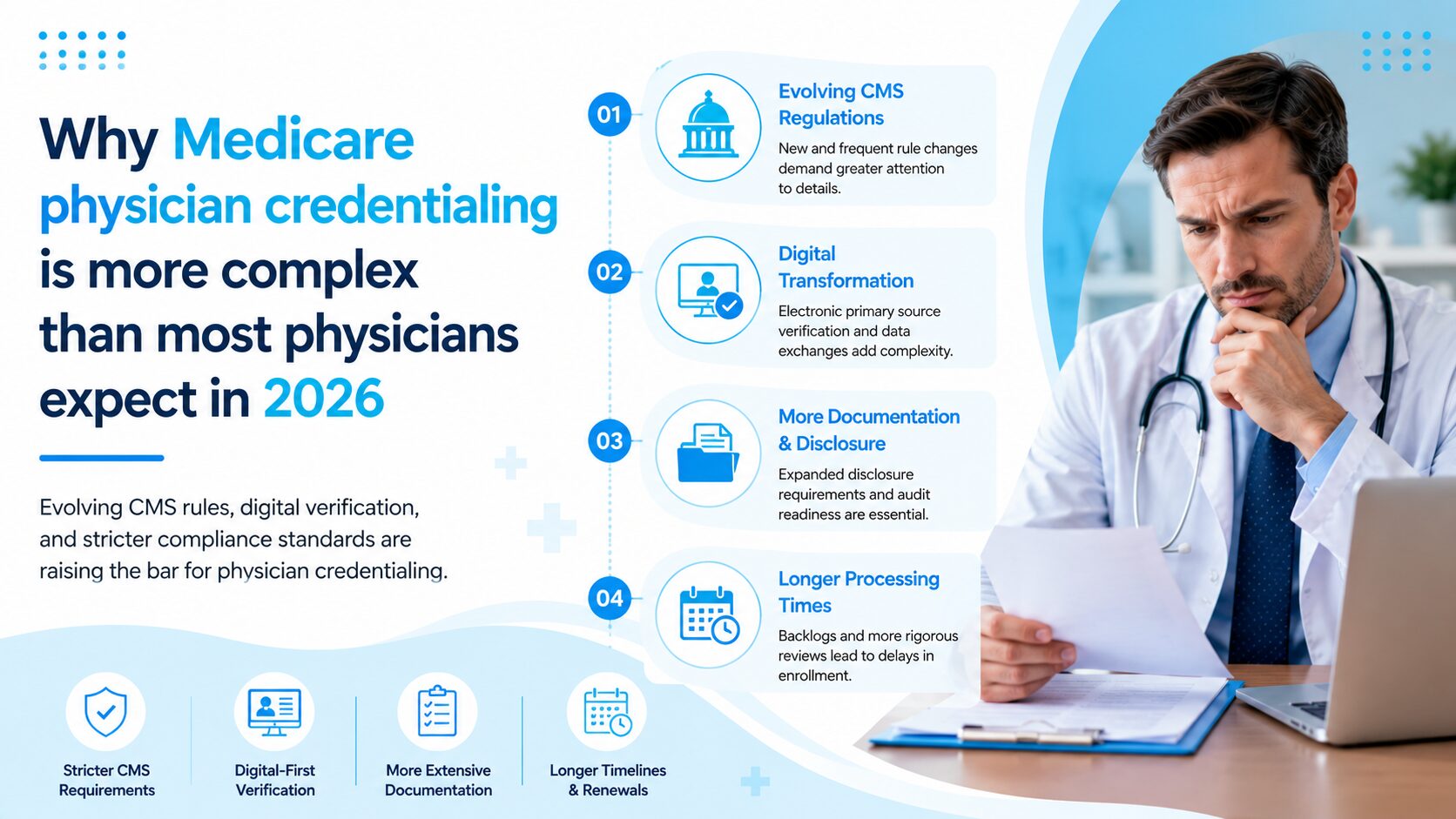
Why Medicare physician credentialing involves multiple CMS systems that must be perfectly aligned
Medicare physician credentialing is not a single system process for physicians, actually it requires synchronization across PECOS (enrollment), NPPES (NPI registry), and I&A (Identity & Access Management). Medicare has complete system, and they stores your data independently, and even a small mismatch, like your different practice address or taxonomy, will trigger application rejection or delay in our enrollment process.
For example, if your NPI record (NPPES) shows a different address than PECOS, CMS may flag your application for inconsistency, forcing revalidation your practice adress. This is why experienced teams like Stars Pro ensure data standardization across all systems before submission, reducing avoidable rework.
How strict CMS data reporting rules within 30 and 90 days create ongoing compliance pressure
CMS require from your side to report any changes in ownership, practice location, or legal structure within 30 days (for critical updates) or 90 days (for general updates). Missing these deadlines can result in revocation of Medicare billing privileges for your healthcare practice.
For new practices, this becomes challenging because operational changes are frequent during the first year their work. Without a compliance tracking system, physicians often miss deadlines, leading to penalties or deactivation from Medicare.
Why even small data inconsistencies in PECOS can reset your entire credentialing timeline
PECOS is highly sensitive to inconsistencies. Common issues include:
- Name differences (Dr. John A. Smith vs John Smith MD)
- Gaps in work history
- Incorrect taxonomy codes
- Expired malpractice insurance
When such discrepancies occur in your application, then Medicare issues a development request, pausing your application. If your practice does not resolved them within the timeframe (usually 30 days), your practice application can be rejected, forcing you to restart the process from scratch, that will create problems for yourself.
How Medicare Administrative Contractors create regional variations in credentialing requirements and timelines
Medicare is federally regulated, but enrollment is processed by regional contractors called MACs. Each MAC has:
- Different processing speeds
- Unique documentation preferences
- Varying communication methods
For example, one MAC may approve within 45 days, while another may take 90+ days for the same application type. This lack of standardization creates confusion, especially for multi-location or multi-state healthcare practices.
Why Medicare processing timelines are misleading and often extended due to clock stoppages and development requests
CMS may advertise processing timelines like 15–50 days, but these only apply to clean applications. In reality:
- Any missing document pauses the clock
- Development requests extend timelines
- Resubmissions restart processing
This means a 60-day process can easily stretch to 120+ days, especially for first-time applicants who are unfamiliar with requirements.
Aaa
How ownership disclosure and managing control requirements add complexity for group practices and startups
CMS requires full disclosure of:
- Owners (5% or more stake)
- Managing employees
- Authorized and delegated officials
For startups need accurate documentation structure, errors in ownership reporting are a major cause of application rejections and audits, particularly under newer CMS transparency rules.
Why revalidation requirements every five years create long-term administrative burden for physicians
Medicare credentialing doesn’t end after approval. Providers must revalidate every 3–5 years, depending on CMS cycles. If your practice fail to revalidate then you may face:
- Deactivation of billing privileges from Medicare
- Claims denial from Medicare
- Payment interruptions from Medicare
Many physicians overlook revalidation deadlines, especially when focused on patient care. A structured tracking system is essential to maintain compliance with Medicare for proper reimbursement.
Add Your Heading Text Here
How PECOS access setup and user role management delay credentialing before the application even begins
Before submitting an application to Medicare for enrollment you need tot:
- Create an I&A account
- Assign roles (Authorized Official, Staff End User)
- Link the organization and individual NPIs
These steps often take days to weeks, especially if approvals are delayed internally. Many practices underestimate this pre-enrollment phase, which delays the actual application start date.
Why physicians must manage both individual and group enrollment structures simultaneously
As an physician you must complete both individual enrollment and group enrollment, then properly link them through reassignment of benefits to ensure accurate billing and payments. If this alignment is missed, even approved providers can face claim denials, delayed reimbursements, and serious cash flow disruptions. In the USA the larget healthcare insurance Medicare requires that:
- Individual enrollment (rendering provider)
- Group enrollment (billing entity)
- Reassignment of benefits (linking both)
If these are not aligned:
- Claims will be denied by Medicare
- Payments may go to the wrong entity
- Billing delays will occur for your healthcare practice
How documentation verification across licenses, malpractice, and work history increases rejection risk
Medicare requires strict verification of your licenses, malpractice coverage, and complete work history, and even minor gaps or expired documents can trigger your credentialing application reviews or rejections. Without accurate and consistent documentation, you often face delays, resubmissions, and extended approval timelines that slow down their ability to bill. The largest healthcare insurance of the USA verifies:
- Your State licenses
- Your Board certifications
- Malpractice insurance
- Employment history (with no unexplained gaps)
Why Medicare credentialing delays directly impact billing eligibility and cash flow for new practices
Until your Medicare credentialing is approved, as a physician you cannot bill as in-network provider to Medicare, which leads to denied claims or significantly reduced reimbursements for your healthcare practice. These delays can disrupt early cash flow, making it difficult for your practice to cover operational costs and maintain financial stability. Until Medicare approves your enrollment:
- You cannot bill as an in-network provider to Medicare
- Your practice claims may be denied or reimbursed at lower rates by Medicare
- Cash flow is significantly reduced on regular basis
Studies and industry benchmarks show new practices can lose 15–30% of expected early revenue due to credentialing delays alone.
How CMS system upgrades and PECOS enhancements in 2026 increase accuracy requirements but add operational complexity
CMS system upgrades and PECOS enhancements in 2026 introduce stricter validation checks and real-time data verification, leaving little room for errors in provider applications. While these updates improve accuracy, they also increase operational complexity, requiring more precise data entry and careful compliance management to avoid delays. CMS continues to upgrade PECOS with:
- Automated validation checks
- Enhanced ownership tracking
- Real-time error detection
While these updates improve accuracy, they also mean less tolerance for errors, requiring more precise and complete applications than ever before.
Why responding to MAC development requests within strict deadlines is critical but often overlooked
When a MAC issues a development request then you have have limited time to submit the required information, and missing this deadline can lead to application rejection or restart. Many physicians overlook these requests due to poor tracking or communication gaps, causing unnecessary delays in Medicare approval. When CMS or a MAC requests additional information
- You typically have 30 days to respond
- Missing the deadline can lead to application rejection
How different submission methods such as PECOS vs paper applications significantly impact processing speed and risk
Submitting through PECOS allows faster processing with built-in error checks, reducing the chances of rejection and delays in your application. In contrast, paper applications often lead to longer processing times, higher error rates, and increased risk of lost or incomplete documentation.
PECOS (online submission):
- Faster processing
- Fewer errors due to built-in validations
Paper applications:
- Higher error rates
- Longer processing times
- Greater risk of lost documents
CMS strongly encourages PECOS, yet some providers still use paper, leading to avoidable delays.
Why Medicare credentialing is not a one-time process but an ongoing compliance lifecycle
Medicare credentialing doesn’t end after approval, it is important for your practice to continuously update information, respond to audits, and complete revalidation to stay compliant with Medicare. Without ongoing monitoring, even small missed updates can lead to claim denials, payment holds, or loss of billing privileges. Credentialing is a continuous process and it involves:
- Initial enrollment of your healthcare practice
- Ongoing updates of your healthcare practice with Medicare
- Revalidation with Medicare on proper time
- Audits and compliance checks on regular basis
It is necessary for your practice do not treat credentialing as a one-time task, if you do so, you can face unexpected disruptions, including claim denials and billing privilege suspension.
How long does Medicare physician credentialing actually take in 2026 based on CMS data?
CMS states that clean applications may process in 30–90 days, but real-world data shows timelines often extend beyond 90–120 days due to errors, development requests, and MAC backlogs.
Why is Medicare credentialing considered more complex than commercial payer enrollment?
Unlike commercial payers, Medicare requires alignment across PECOS, NPPES, and CMS compliance systems, all acting as a source of truth. In 2026, CMS has shifted to strict data validation and automated oversight, meaning errors are no longer tolerated, they directly impact billing privileges and revenue of your healthcare practice.
What percentage of Medicare applications get delayed due to errors or missing information?
Industry benchmarks show 30–40% of Medicare enrollment applications face delays, primarily due to incomplete documentation, mismatched data, or incorrect CMS form submissions.
How do credentialing delays financially impact new medical practices?
Every day without Medicare approval means no reimbursement for services provided, effectively freezing revenue cycles. For example, a practice generating $30,000/month can lose up to $90,000 over a 90-day delay, creating serious financial pressure during startup.
What happens if a physician submits claims before Medicare credentialing is approved?
Claims submitted before the effective enrollment date are automatically denied, with little to no guarantee of retroactive payment.
Why are PECOS data mismatches such a major risk in 2026?
CMS has reinforced PECOS as the primary system of record, and any mismatch between PECOS, NPPES, or internal records is considered non-compliance. Inaccurate data can now lead to revocation of billing privileges and repayment of previously received funds, not just delays.
What are the strict CMS reporting requirements physicians must follow?
CMS requires providers to report:
- Ownership changes within 30 days
- Practice location updates within 30 days
- Other updates within 90 days