
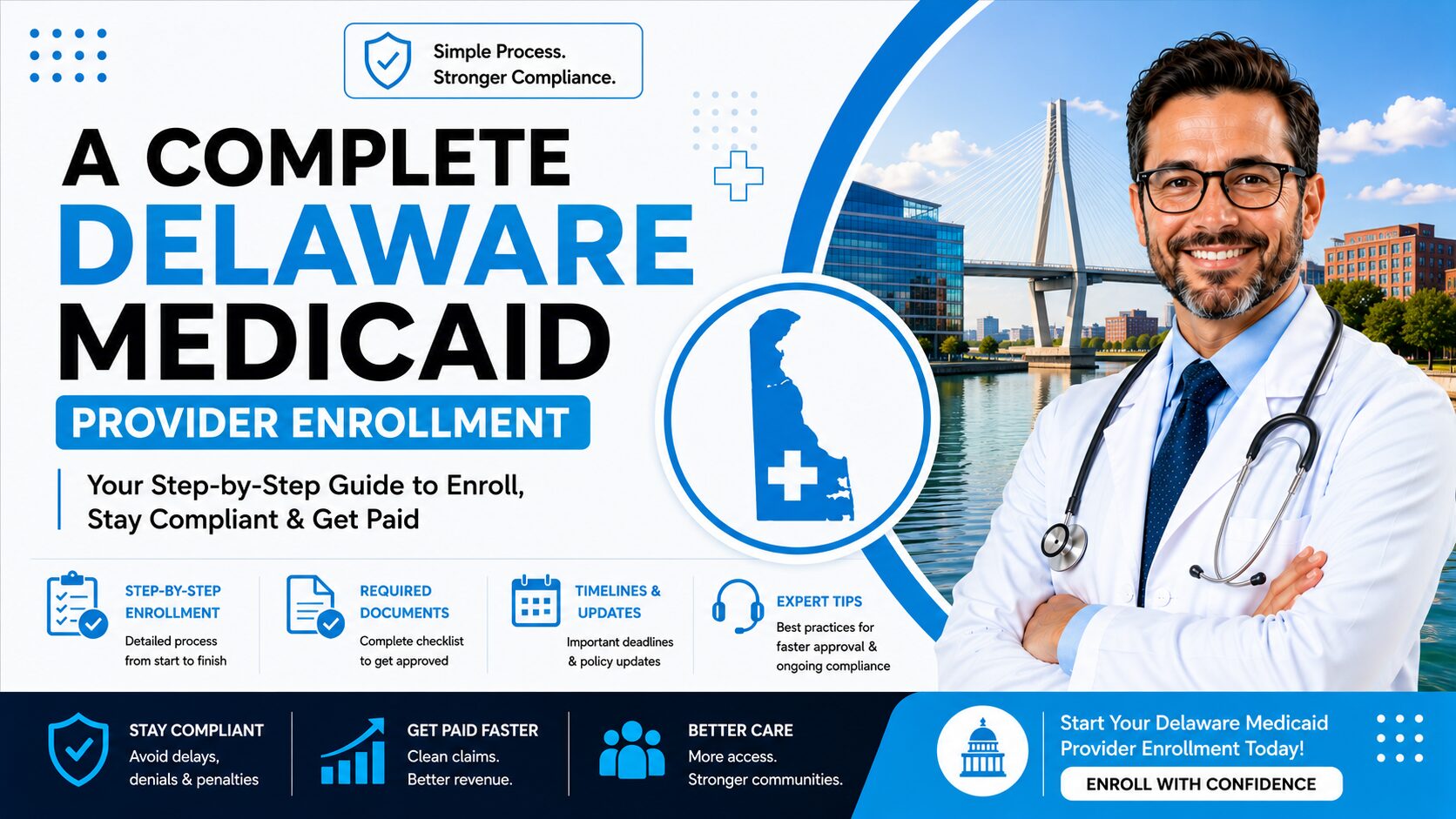
Delaware Medicaid Provider Enrollment Guide Everything You Need to Know in 2026
If you’re a healthcare provider in Delaware looking to serve Medicaid patients in your state, the first and most important step is that you need to enroll with Delaware Medicaid, officially known as the Delaware Medical Assistance Program (DMAP).
But as a provider you know that it is a harsh truth that the enrollment process can feel overwhelming. Between gathering documents, navigating the online portal, meeting licensure requirements, and managing timelines, there’s a lot that can go wrong. That’s exactly why we put together this complete Delaware Medicaid provider enrollment guide to walk you through every step of the process. And if you’d rather skip the hassle entirely, at Stars Pro’s, our credentialing team is here to handle it all for your medical practice.
What Is Delaware Medicaid Provider Enrollment?
Delaware Medicaid, operated by the Delaware Division of Medicaid and Medical Assistance (DMMA), is a state and federally funded program that provides healthcare coverage to low-income individuals, families, children, pregnant women, seniors, and people with disabilities.
To get paid for services you provide to Medicaid beneficiaries in Delaware, you must be an enrolled, approved provider with DMAP. Without active enrollment, any claims you submit will be denied, no matter how legitimate or medically necessary the services were.
Who Needs to Enroll as a Delaware Medicaid Provider?
Delaware Medicaid provider enrollment is required for a wide range of healthcare professionals and organizations, including:
- Physicians and specialists
- Nurse practitioners and physician assistants
- Behavioral health and mental health providers
- Dentists and oral health professionals
- Home health agencies
- Hospitals and outpatient facilities
- Durable medical equipment (DME) suppliers
- Long-term care and skilled nursing facilities
- Pharmacies and pharmacy technicians
Whether you’re an individual practitioner or a large group practice, if you want to bill Delaware Medicaid, you need to go through the official enrollment process.
Why Provider Enrollment Matters for Your Practice’s Revenue Cycle
Enrollment isn’t just a regulatory checkbox; it directly impacts your bottom line. Delays in enrollment mean delayed revenue. Errors in your application can lead to denials that set you back weeks or even months. And missing revalidation deadlines can result in deactivation, putting a full stop to your Medicaid billing. A smooth, accurate enrollment process is the foundation of a healthy revenue cycle. That’s something we take very seriously at Stars Pro.
Types of Providers Eligible for Delaware Medicaid Enrollment
Before you start the application, it’s important to understand what type of provider you are, because Delaware Medicaid distinguishes between several provider categories, and the requirements differ for each.
Individual Providers vs. Group/Organizational Providers
If you’re a solo practitioner, you’ll apply as an individual provider. If you’re part of a group practice, hospital, or healthcare organization, you’ll typically need both individual and group enrollments, one for the billing entity and one for each rendering provider.
Rendering, Billing, and Ordering/Referring Providers
Delaware Medicaid also separates providers by their role in the care delivery and billing process:
- Rendering providers are the ones who actually deliver the service.
- Billing providers are responsible for submitting claims on behalf of the practice or organization.
- Ordering/Referring providers are those who order services or refer patients but may not directly render the billed service.
Behavioral Health, Dental, and Long-Term Care Providers
Certain specialty categories including behavioral health, dental, and long-term care, have additional program-specific requirements. If you fall under one of these categories, be prepared for a more detailed application process that may include program-specific agreements, additional credentialing, and separate portal registrations.
Delaware Medicaid Enrollment Requirements
This is where many providers run into trouble, not because the requirements are impossible to meet, but because a missing document or overlooked step can stall the entire application. Here’s what you need to have in order before you hit submit.
Licensure and Certification Prerequisites
All providers must hold a current, unrestricted license to practice in the state of Delaware. Specialty certifications relevant to your provider type may also be required. You need to make sure your license is active and in good standing any restrictions, suspensions, or pending disciplinary actions can trigger delays or denials.
NPI (National Provider Identifier) Requirements
You must have an active Type 1 NPI (for individual providers) or Type 2 NPI (for organizations and group practices). Your NPI information must be consistent across all systems, your NPPES record, your application, and your state license database. Even a small discrepancy in your name, address, or taxonomy code can cause problems.
Required Documentation Checklist Before You Apply
Having all your documents ready before starting the application will save you significant time and frustration. Here’s a core checklist:
- Valid Delaware state license(s)
- Active NPI (Type 1 and/or Type 2)
- Federal Tax ID (EIN) or Social Security Number (for sole proprietors)
- DEA certificate (if applicable)
- Proof of malpractice insurance
- Board certification documentation (if applicable)
- Voided check or bank letter for Electronic Funds Transfer (EFT) setup
- W-9 form
- CLIA certificate (for labs or providers performing lab services)
- Medicare provider number (if applicable)
Background Check and Exclusion Screening Requirements
Delaware Medicaid requires that all providers be screened against federal and state exclusion databases, including the OIG (Office of Inspector General) exclusion list and the SAM (System for Award Management) database. Any provider found on these lists will be rejected. Before applying, screen yourself and any key organizational personnel to confirm clean standing.
Step-by-Step Delaware Medicaid Provider Enrollment Process
Now that you know what’s required, let’s walk through the actual application process from start to finish.
Setting Up Your DMAP Provider Portal Account
Delaware Medicaid uses an online enrollment portal managed through the state’s DMAP system. Your first step is to create an account on the portal, set up your login credentials, and familiarize yourself with the interface before diving into the application.
Completing the Online Enrollment Application
Once your account is set up, you’ll begin filling out the enrollment application. This includes:
- Provider demographic information
- Taxonomy code selection
- Practice location details
- Service type and specialty information
- Billing information and EFT setup
Submitting Supporting Documents
After completing the application form, you’ll upload all required supporting documentation. Make sure every document is current, legible, and properly formatted. Expired licenses or blurry scans are common causes of delays.
Awaiting Review and Approval
Once submitted, your application enters DMAP’s review queue. A processor will verify your information, check exclusion databases, and confirm your licensure status. If anything is missing or incorrect, you’ll receive a request for additional information.
How Long Does Delaware Medicaid Enrollment Take?
Processing times can vary. Under normal circumstances, Delaware Medicaid enrollment can take anywhere from 30 to 90 days. However, incomplete applications, high application volumes, or issues flagged during screening can extend this timeline significantly. Planning ahead and submitting early is always the smarter move.
Common Reasons for Application Rejection
Even experienced providers get rejected on the first attempt. The most common reasons for rejection are:
- Mismatched NPI information between NPPES and the application
- Expired or restricted licensure
- Missing or incorrect tax identification information
- Incomplete service location details
- Exclusion list flags on the provider or associated personnel
- Unsigned or improperly completed forms
Delaware Medicaid Managed Care Organizations (MCOs)
Here’s something many providers don’t realize until it’s too late; enrolling with Delaware Medicaid (DMAP) is not the same as enrolling with Delaware’s Medicaid managed care plans.
Understanding Delaware’s MCO Landscape
Delaware Medicaid operates through both a fee-for-service (FFS) system and managed care organizations (MCOs). Medicaid beneficiaries may be enrolled in managed care plans, which means that even if you’re enrolled with DMAP, you may also need to separately credentialing and contract with each MCO to serve patients enrolled in those plans.
How to Enroll with Delaware’s Medicaid MCO Plans
Each MCO has its own credentialing and contracting process. You’ll need to submit separate applications, provide documentation, and go through the MCO’s internal credentialing committee before you’re approved to see their members.
Difference Between Fee-for-Service and MCO Enrollment
In the fee-for-service system, providers bill DMAP directly. In the MCO model, providers bill the managed care plan. Many providers need enrollment in both systems to maximize their Medicaid patient access and reimbursement.
Revalidation and Maintenance of Delaware Medicaid Enrollment
Getting enrolled is just the beginning. Staying enrolled requires ongoing attention to revalidation requirements and provider record maintenance.
When and How to Revalidate Your Delaware Medicaid Enrollment
Delaware Medicaid requires providers to revalidate their enrollment periodically, typically every three to five years, depending on provider type. DMAP will send a revalidation notice when the time comes, but relying solely on that notice is risky. Many providers miss revalidation deadlines simply because the notice went to an old address or got buried in email.
Updating Provider Information After Enrollment
Any time your practice information changes address, phone number, new practice location, ownership change, or updated licensure, it is your responsibility to notify DMAP promptly. Failing to update your information can result in misdirected payments, compliance issues, or enrollment deactivation.
Consequences of Missing Revalidation Deadlines
Missing your revalidation deadline means DMAP can deactivate your enrollment, which immediately stops any Medicaid payments. Getting re-enrolled after deactivation takes time and puts your revenue on hold. The good news is that this is entirely avoidable with proper tracking and reminders.
Delaware Medicaid Credentialing and How Stars Pro Makes It Effortless
At Stars Pro, we specialize in provider credentialing and enrollment services, and we know how much is at stake for your practice. Here’s how we take the complexity off your plate.
What Is Medicaid Credentialing and Why Does It Differ from Enrollment?
Provider enrollment is the process of getting approved to bill Delaware Medicaid. Credentialing, on the other hand, is the process of verifying a provider’s qualifications, their education, training, licenses, certifications, work history, and malpractice records through primary source verification.
While enrollment and credentialing are closely related, they’re not the same thing. Medicaid credentialing is particularly important when enrolling with MCOs, which typically require full credentialing before granting network participation.
Stars Pro’s Delaware Medicaid Credentialing Process Explained
When you partner with Stars Pro for your Delaware Medicaid credentialing, here’s what we do for you:
- Conduct a thorough review of your existing credentials and documentation
- Identify any gaps or issues that could cause delays before we submit
- Complete and submit your DMAP enrollment application accurately and on time
- Initiate credentialing applications with Delaware Medicaid MCOs as needed
- Monitor your application status and follow up proactively with DMAP
- Communicate every update to you so you’re never left in the dark
How Stars Pro Handles Primary Source Verification for Delaware Providers
Primary source verification (PSV) is one of the most time-consuming parts of the credentialing process. Our team contacts licensing boards, medical schools, training programs, and malpractice carriers directly to verify every credential on your application.
What to Expect When You Work with Stars Pro
Our goal is to move as fast as the system allows. With a complete set of documents and quick responses to our information requests, we aim to have your Delaware Medicaid enrollment submitted within days of onboarding, and we stay on top of the follow-up every step of the way.
How Stars Pro Reduces Credentialing Delays and Claim Denials
Most credentialing delays come from avoidable errors, wrong taxonomy codes, expired documents, mismatched NPI data. Our experienced credentialing specialists catch these issues before they become rejections. That means fewer delays, fewer denied claims, and faster access to Medicaid reimbursements for your practice.
Common Challenges in Delaware Medicaid Provider Enrollment
Even with the best preparation, providers often hit roadblocks. Being aware of these common challenges ahead of time can help you avoid them or know how to respond when they arise.
Incomplete or Incorrect Application Submission
This is the number one cause of delays. Something as simple as a missing taxonomy code or an unsigned form can send your application back to square one. Always double-check every field before submitting.
Delays Due to Missing Licensure or Exclusion Issues
If your license isn’t current or your name appears on an exclusion list, even in error DMAP will put a hold on your application. Clearing these issues takes time, which is why a pre-submission audit is so valuable.
Managing Multi-State Enrollment Alongside Delaware Medicaid
If you practice across state lines or are enrolling in multiple state Medicaid programs simultaneously, the administrative load can quickly become unmanageable. Stars Pro is experienced in multi-state credentialing and can manage all of your enrollments in parallel.
Tips to Speed Up Your Delaware Medicaid Enrollment
Want to give your application the best possible chance of quick approval? Keep these tips in mind.
Prepare Your Documents Before Starting the Application
Don’t start the online application until you have every required document in hand. A partially completed application that sits idle while you gather materials can create unnecessary complications.
Respond Promptly to DMAP Information Requests
If DMAP reaches out with a request for additional information, respond as quickly as possible. Delayed responses push your application further back in the queue and extend your overall timeline.
Verify Your NPI Data Before You Submit
Log into NPPES before submitting your application and confirm that your name, address, taxonomy codes, and other information are accurate and up to date. Any mismatch between your NPI record and your application will trigger a review.
Work with a Professional Credentialing Partner Like Stars Pro
The single most effective way to speed up your Delaware Medicaid enrollment? Let our expert handle it. Stars Pro’s credentialing specialists know the DMAP system inside and out. We know what reviewers look for, what mistakes to avoid, and how to handle delays when they arise. Our clients consistently see faster approvals and fewer rejections compared to self-managed enrollments.