
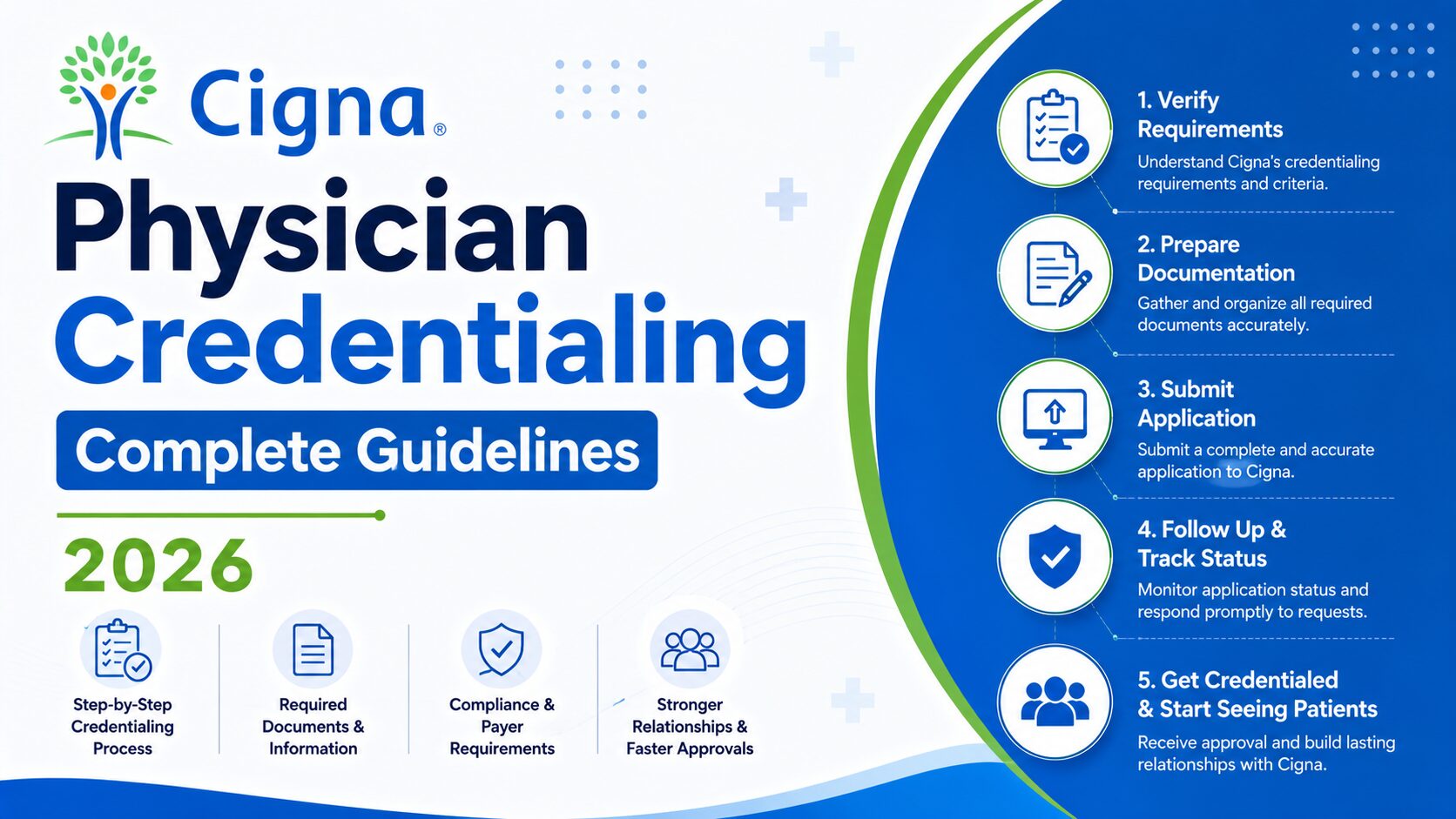
What is Cigna Physician Credentialing?
Cigna physician credentialing is a structured, multi-layer verification process where Cigna expert team evaluates a provider’s clinical qualifications, professional history, and compliance standing before granting in-network participation to that provider. This Cigna credentialing process includes primary source verification (PSV) of licensure, board certification, malpractice history, sanctions, and work experience.
Unlike simple enrollment, credentialing is a risk-control mechanism for healthcare practices in the USA. It is clear that even small discrepancies, like a date mismatch in work history, can trigger delays or rejections. At Stars Pro, we treat credentialing as a compliance-driven workflow, not just paperwork, ensuring every data point aligns across CAQH, NPI, and payer submissions.
Why Cigna Credentialing is Important for Providers?
Credentialing with Cigna is a foundational step for any provider who wants to participate in-network and generate consistent revenue. Until both credentialing and contracting are fully approved, providers cannot submit claims or receive reimbursements, which creates a revenue gap that can impact cash flow and operational stability if not managed efficiently.
Beyond financial implications, credentialing plays an important role in patient access and practice growth. Being listed as an in-network provider with Cigna increases visibility, builds patient trust, and drives higher patient volume, as most patients prefer providers covered under their insurance plans.
Our well-managed credentialing process ensures faster approvals, fewer errors, and quicker transition to billing readiness. At Stars Pro, we streamline the entire workflow by minimizing delays, improving accuracy, and aligning credentialing with revenue cycle processes so your practice revenue loss can be avoided and you can focus on delivering quality care.
Cigna Credentialing vs Contracting Main Differences
Credentialing and contracting are two distinct but equally critical steps in the Cigna enrollment process. Credentialing focuses on verifying a provider’s qualifications, background, and compliance, while contracting determines reimbursement rates, payment terms, and participation conditions within the network. Both must be completed before a provider can begin billing and receiving payments.
A common mistake providers make is completing credentialing but delaying the contracting phase, which leaves them approved but unable to generate revenue. This gap can lead to significant financial losses, as services rendered during this period may not be reimbursed or may require complex retroactive billing processes.
Contract terms also play a major role in long-term profitability, as reimbursement rates and clauses directly affect revenue outcomes. At Stars Pro, we ensure a seamless transition from credentialing to contracting while supporting providers in securing competitive, financially sustainable agreements that align with their practice goals.
Step-by-Step Cigna Credentialing Process
The process begins with CAQH completion and extends through multiple verification layers, internal payer reviews, and committee approvals. Each stage has hidden checkpoints that are not visible to providers.
The biggest inefficiency occurs in “pending status”, where applications sit idle due to missing clarifications. Stars Pro actively follows up at each stage, preventing silent delays.
| Stage | What Actually Happens (Payer Side) | Common Delay Triggers | Impact on Timeline | Stars Pro Intervention |
|---|---|---|---|---|
| CAQH Profile Completion | Provider data is entered, verified, and attested in CAQH database | Missing disclosures, outdated info, non-attestation | Application cannot be initiated | Full profile audit, error correction, and timely attestation |
| Application Submission to Cigna | Data is pulled from CAQH and submitted into Cigna system | Data mismatch (NPI, address, work history) | Application rejection or reset | Pre-submission validation across CAQH, NPI, and documents |
| Intake & Initial Review | Cigna reviews application for completeness | Missing documents, incomplete sections | Moves to “pending provider info” | Immediate document reconciliation and resubmission |
| Primary Source Verification (PSV) | Direct verification of license, board cert, malpractice, etc. | Slow responses from boards, gaps in history | Major bottleneck (longest phase) | Continuous follow-up with verification sources |
| Payer Review & Clarifications | Internal team reviews flagged issues or inconsistencies | Unexplained work gaps, malpractice history | Application stuck in “pending review” | Proactive clarification handling and escalation |
| Credentialing Committee Review | Final approval decision by committee | Internal backlog, limited review cycles | Adds 2–4 weeks delay | Escalation and status tracking |
| Contracting & Enrollment Activation | Contract issued, signed, and provider loaded into system | Delayed contract signing, rate negotiation issues | Billing cannot begin | Contract follow-up and activation coordination |
Required Documents for Cigna Credentialing
Documentation is not just about submission, it’s about consistency across systems. For example, if your CAQH lists a different address than your NPI registry, your application may be flagged.
As an experienced provider, you need to underestimate the importance of timeline-sensitive documents like malpractice insurance or DEA certificates. At Stars Pro, our certified team maintains a document control system to ensure all records are valid, synchronized, and audit-ready.
Cigna Credentialing Workflow – Realistic Process Breakdown
| Stage | What Actually Happens (Payer Side) | Common Delay Triggers | Impact on Timeline | Stars Pro Intervention |
|---|---|---|---|---|
| CAQH Profile Completion | Provider data is entered, verified, and attested in CAQH database | Missing disclosures, outdated info, non-attestation | Application cannot be initiated | Full profile audit, error correction, and timely attestation |
| Application Submission to Cigna | Data is pulled from CAQH and submitted into Cigna system | Data mismatch (NPI, address, work history) | Application rejection or reset | Pre-submission validation across CAQH, NPI, and documents |
| Intake & Initial Review | Cigna reviews application for completeness | Missing documents, incomplete sections | Moves to “pending provider info” | Immediate document reconciliation and resubmission |
| Primary Source Verification (PSV) | Direct verification of license, board cert, malpractice, etc. | Slow responses from boards, gaps in history | Major bottleneck (longest phase) | Continuous follow-up with verification sources |
| Payer Review & Clarifications | Internal team reviews flagged issues or inconsistencies | Unexplained work gaps, malpractice history | Application stuck in “pending review” | Proactive clarification handling and escalation |
| Credentialing Committee Review | Final approval decision by committee | Internal backlog, limited review cycles | Adds 2–4 weeks delay | Escalation and status tracking |
| Contracting & Enrollment Activation | Contract issued, signed, and provider loaded into system | Delayed contract signing, rate negotiation issues | Billing cannot begin | Contract follow-up and activation coordination |
Cigna Credentialing Timeline
While standard timelines are quoted as 60–120 days, real-world scenarios often extend beyond that due to payer backlog, PSV delays, and provider-side errors.
The key factor is not just submission but active lifecycle management. Stars Pro reduces idle time by maintaining continuous payer communication.
Cigna Credentialing Timeline Variability
| Scenario | Average Timeframe | Primary Cause | What It Means for Providers |
|---|---|---|---|
| Clean Application | 60–90 days | Complete and accurate submission | Smooth processing with minimal delays |
| Minor Errors Present | 90–120 days | Data inconsistencies or missing details | Rework required, slows approval |
| No Active Follow-Up | 120–150+ days | Lack of status tracking and communication | Application remains stuck in pending |
| Managed by Stars Pro | 45–90 days | Proactive monitoring and error prevention | Faster approvals and quicker revenue activation |
Common Problems in Cigna Credentialing
Credentialing challenges with Cigna rarely stem from major compliance failures; instead, they are often caused by small inconsistencies that accumulate across systems over time. Even minor discrepancies, such as mismatched provider names, outdated addresses, or incomplete work history, can trigger verification issues and delay the entire approval process.
Another critical issue is the lack of active management after submission. Many providers assume the process is automatic, but without consistent follow-up, applications can remain in pending status for weeks. At Stars Pro, our dedicated specialists take full ownership of each case, ensuring continuous tracking, timely updates, and faster resolution, below are some main points that cause problems in your enrollment with Cigna.
- Inconsistent data between CAQH, NPI, and application forms
- Incomplete or outdated CAQH profile and missing attestation
- Expired licenses, DEA certificates, or malpractice insurance
- Unexplained gaps in work history or missing employment details
- Incorrect taxonomy codes or provider classification
- Missing supporting documents during initial submission
- Lack of follow-up with Cigna during verification stages
- Delays in primary source verification from third parties
- Failure to respond quickly to payer clarification requests
- Errors in demographic or practice location information
What Are Key Challenges & Difficulties Providers Face in Cigna Credentialing?
Credentialing is resource-intensive, if your practice struggles with staff bandwidth, lack of expertise, and fragmented systems. Managing multiple providers or locations multiplies complexity exponentially.
- Navigating complex and payer-specific credentialing requirements → Stars Pro simplify credentialing and ensures accurate compliance from the start.
- Long and unpredictable approval timelines → Stars Pro’s expert team accelerates approvals through proactive follow-ups and efficient workflows.
- Limited visibility into application status → Stars Pro’s specialists provide continuous tracking and real-time updates.
- Managing multiple providers and locations → Stars Pro streamlines multi-provider credentialing with structured systems.
- Frequent rework due to minor errors → Stars Pro’s specialists eliminate errors with detailed pre-submission audits.
- Delays in primary source verification → Stars Pro actively follows up to prevent verification bottlenecks.
- Difficulty maintaining CAQH profiles → Stars Pro manages updates and ensures continuous compliance.
- Poor coordination between credentialing and billing → Stars Pro aligns processes for seamless revenue flow.
- Missing re-credentialing deadlines → Stars Pro tracks renewals and maintains ongoing compliance.
- Challenges in understanding contract terms → Stars Pro provides insights to secure profitable agreements.
Laws & Compliance Requirements
Credentialing is governed by a combination of federal regulations, payer policies, and accreditation standards (NCQA). Non-compliance can lead to denial, audits, or even legal penalties.
For example, inaccurate billing tied to improper credentialing can trigger False Claims Act violations. At Stars Pro, our experts ensure every application aligns with regulatory frameworks.
Regulatory Impact Table
| Regulation | Scope | Credentialing Impact | Risk Level |
|---|---|---|---|
| HIPAA | Data security | Secure data handling | High |
| NCQA | Quality standards | Credentialing benchmarks | High |
| CMS | Federal guidelines | Enrollment alignment | Medium |
| FCA | Fraud prevention | Billing compliance | Severe |
Cigna Credentialing for New vs Established Practices
New providers entering the Cigna network often face more intensive compliance due to the absence of credentialing history, requiring detailed verification of education, training, and work experience. This can lead to longer approval timelines, especially if documentation is incomplete or not properly aligned across systems.
Established providers, while benefiting from prior credentialing records, often encounter challenges related to data consistency across multiple payers, outdated information, or discrepancies between CAQH, NPI, and internal records. These issues can still cause delays if not proactively managed.
At Stars Pro, our credentialing team has developed structured credentialing framework for new practices to ensure a smooth start, while also optimizing and standardizing processes for established providers, helping you maintain accuracy, scalability, and faster approvals across all payer enrollments.
Re-Credentialing and Ongoing Monitoring
Re-credentialing is a continuous and essential part of maintaining participation in the Cigna network, typically required every 2–3 years along with ongoing monitoring of licenses, certifications, and any sanctions or compliance updates. This ensures providers remain qualified and meet payer standards over time.
Failure to meet re-credentialing deadlines or maintain updated records can lead to serious consequences, including temporary suspension, removal from the network, or interruption in billing and reimbursements. These disruptions can directly impact both revenue and patient continuity of care.
At Stars Pro, we implement proactive tracking and monitoring systems that manage the entire credentialing lifecycle, ensuring timely renewals, real-time updates, and full compliance, so providers can avoid disruptions and maintain uninterrupted revenue flow.
How Credentialing Impacts Billing & Revenue Cycle
Credentialing has a direct and measurable impact on the billing process and overall revenue cycle as a provider, you cannot submit claims or receive payments until you are fully credentialed and contracted with Cigna. Even a delay of 60–90 days can result in significant revenue loss due to unbilled services and delayed cash flow.
In addition, inaccurate or inconsistent credentialing data, such as incorrect provider details or mismatched enrollment information, can lead to repeated claim denials, payment rejections, and increased administrative rework. These issues not only slow down reimbursements but also strain internal resources.
At Stars Pro, we strategically align credentialing with revenue cycle management (RCM) processes, ensuring that providers are fully prepared to bill immediately upon approval, reducing denials, accelerating reimbursements, and maintaining a steady revenue stream.
In-House vs Outsourced Credentialing
In-house teams often lack payer-specific expertise and operate reactively. Outsourced services bring structured workflows, automation, and payer relationships. At Stars Pro, our experts consistently deliver faster approvals and lower error rates due to specialized expertise.
Performance Comparison
| Metric | In-House | Stars Pro |
|---|---|---|
| Approval Time | 120–150 days | 60–90 days |
| Error Rate | 20–30% | 5–10% |
| Follow-Up Frequency | Low | High |
| Denial Rate | Higher | Lower |
How We Speed Up Cigna Credentialing
The speed of Cigna credentialing largely depends on three critical factors, accuracy of submitted data, consistent follow-up, and alignment across systems like CAQH, NPI, and payer records. Providers who maintain updated profiles, submit complete documentation, and actively track their applications can significantly reduce processing delays.
However, even with proper preparation, many applications slow down due to lack of follow-up or missed payer communications. Without active management, applications can remain in pending status for extended periods, delaying approvals and revenue generation.
At Stars Pro, we accelerate credentialing by performing thorough pre-submission audits, ensuring complete data accuracy, and maintaining continuous engagement with Cigna throughout the process by minimizing delays and helping your practice achieve faster approvals and quicker billing readiness.
What do physicians expect from credentialing services?
Modern physicians expect credentialing services to be efficient, transparent, and fully managed, allowing them to focus on patient care rather than administrative tasks. They look for streamlined processes, clear communication, and minimal involvement while ensuring that everything is handled accurately and on time by the credentialing company.
In addition to speed and convenience, providers also expect visibility into the progress of their applications, along with proactive updates and quick resolution of any issues that arise during the credentialing process. A lack of transparency or delays can lead to frustration and lost revenue opportunities.
At Stars Pro, we deliver a provider-centric approach with dedicated support, real-time tracking, and performance-driven workflows that align credentialing with billing and revenue goals, ensuring measurable results, faster approvals, and a smoother overall experience.